
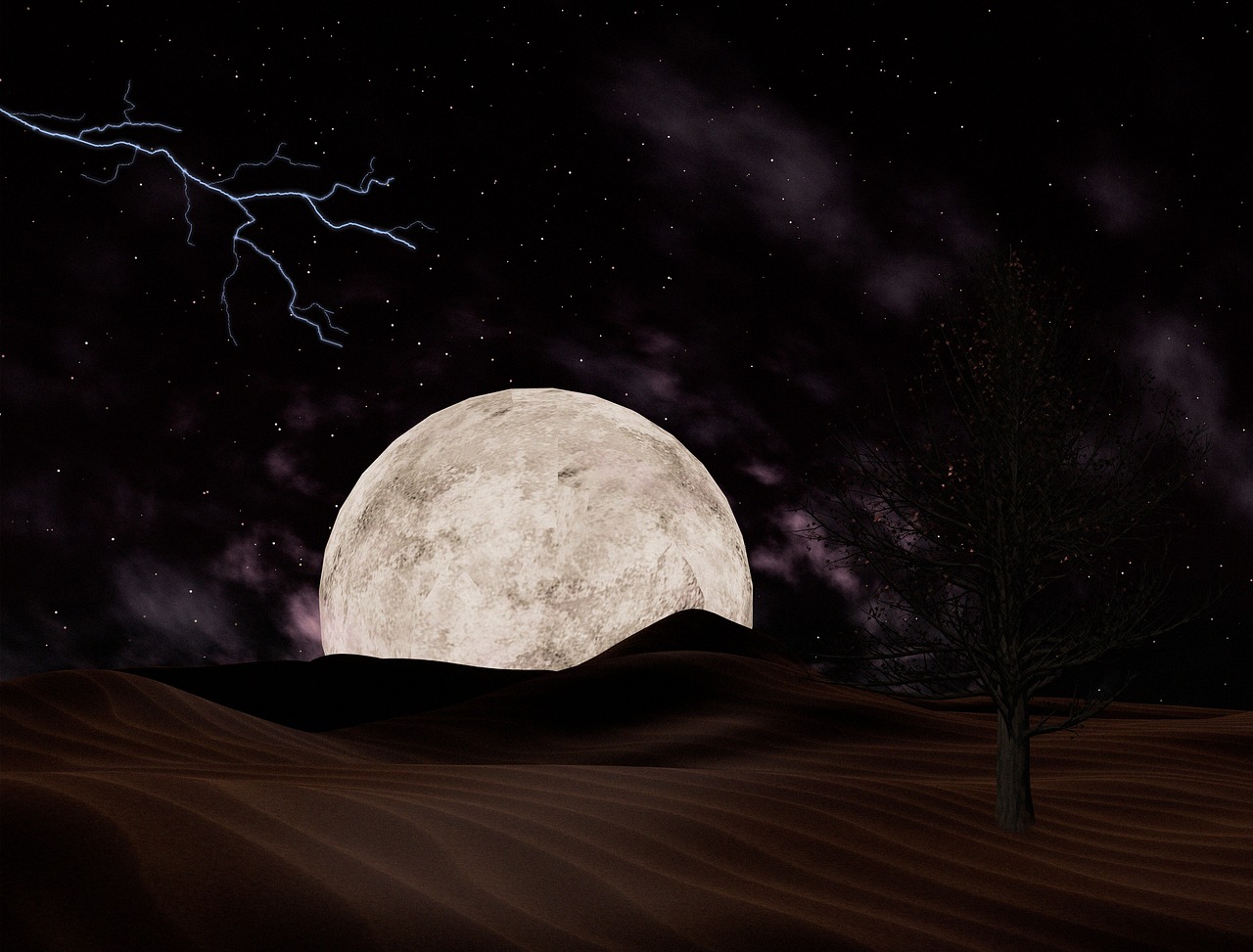
The desert Raml al Zaman can only be crossed at night, under the light of the full moon. Even then it is incredibly dangerous—full of spirits and memories that would draw down anyone who encounters them into the suffocating sands.
Legend has is that anyone who crosses the desert will reach the place where Time began. They will receive Enlightenment, unlocking great powers which have long remained dormant in the world.
If they do not go mad in the process, of course.
Table of Contents
Side Quest Tone
This side quest is intended to be an adventure of wonder and exploration as much as it is of danger. It should be self-consistent without being strictly logical. It should be magical.
Sources of inspiration include Tartarus in the animated film Sinbad: Legend of the Seven Seas, and the Jorge Luis Borges short stories “The Garden of Forking Paths” and “The Immortal”.
This is the time to play fast and loose with the rules and build tension through storytelling rather than combat. The landscape itself is the enemy. The stakes may vary depending on the tone of your game: failure could mean death, or loss of memories. Or loss of time.
Entering the Desert
Raml al Zaman is a wild and treacherous place of shifting sand dunes and sinking pits. But at night, under the light of the full moon, ghostly footprints appear in the sand which lead the way deep into the desert. If you follow them exactly, you just might survive. You have six hours to cross the desert and return.
Start your player characters at the edge of the desert, which is marked by two standing stones that create a sense of passing through a door into another world. The footprints become visible as soon as the characters pass between the stones, leading over a dune into the distance.
When the party begins walking, they hear whispering in the wind, and they are struck with a memory. Have each player roll 2d6 twice to determine who the memory belongs to and what emotions it brings up.
| Result | The memory belongs to… | And is tied to strong feelings of… |
| 2-3 | Yourself in the future | Desire |
| 4-7 | Yourself in the past | Failure |
| 8-10 | Someone else in the party | Terror |
| 11-12 | Your greatest enemy | Obsession |
Work with the players to decide the details of the memory. Let players choose a memory for their own character’s past, or if another player’s character receives one of their character’s memories.
Keep the memories as simple sketches or concepts without too many details. Leave room for these memories to warp and grow out of control as the adventure progresses.
The Lost City
After nearly an hour of following the ghostly footprints up and down mounds of sand, a row of broken shapes becomes visible in the moonlight. It is the remains of a once-great city. As the party approaches, wind blows sands which shift to reveal staircases and walls and conceal them just as quickly as they appeared. The footprints lead directly to the city.
When the party reaches the stone threshold, the memory they experienced before manifests in front of them. Each character sees an illusion of something from their memory that draws them into danger.
If any of the illusions are touched, they dissolve into sand. Dangers could include falling into a pit that fills with sand, getting crushed under a collapsing stone column, wandering out alone into the desert, becoming paralyzed with fear while something spectral drains their life away, etc.
I would have each player make a relevant check to determine the degree of danger each of them gets into, and them give them a chance to extricate themselves and their companions.
The Genie Lamp
Tucked away in the lost city is a brass oil lamp that contains a djinn. Rubbing the lamp released the djinn, which does not speak but will obey the commands of whoever released it. After following three commands, the djinn is free and will stick around only long enough to betray its former master.

The Bridge to the Sky
After two more hours, the party reaches a glass bridge that stretches up into the sky. At the top arc of the bridge is a floating garden enclosed in a stone wall. The footprints lead up the bridge.
The memories return again while the characters are crossing the bridge, more extreme and blown out of proportion than before. Give each player a chance to resist the thrall of their memory.
Raml al Zaman demands tribute. If a character succumbs to their memory, they may have a chance to survive if they give something up. This could be their most powerful magic item, a memory of a personal quest, twenty years of their life, etc. as appropriate to the memory and situation. Failure to let go of what is demanded results in the character falling from the bridge and getting swept away by the sands below.
For extra drama, you may allow a character to make an extreme sacrifice in order to save someone else.
The Garden of All Things
The glass bridge ends at a wooden gate in the stone wall, which opens easily to the touch, emitting a sound like a gong. Inside is a riotous garden that is visibly growing as the characters watch, large purple blooms opening before their very eyes, and bizarre birds flying overhead. The desert is nowhere to be seen. Neither are the ghostly footprints that they have been following.
Deeper in the garden is an open courtyard with a large banquet table set up for a lavish feast. There is one person sitting at the table. Each character perceives the person as someone else—some as a person who they trust implicitly, and others as someone who they despise. Using magic to see the person’s real identity reveals that they are not there at all.
The illusory person tries to persuade the party to take a break and enjoy the feast. Eating or drinking anything from the table causes them to fall into a deep sleep that they cannot be woken from. Taking anything from the table, whether food or item, casts a curse which prevents them from sleeping while it is in their possession.
Elsewhere in the garden is a long reflection pool. Looking into the pool reveals a scene of the party crossing a desert at night, pausing from time to time to respond to something that only they can see.
By this time the player characters are probably reaching some sort of Conclusion. Whatever conclusion they reach (unless it is terribly outlandish) is now the truth, and whatever they decide to do about it is the Solution.
If they have trouble coming up with a solution, tell them that they find something else in the garden, something that is obviously out of place such as a standing gong, a perfectly ordinary tabby cat, or a rocking chair from their favorite inn. However they decide to interact with that thing is now the Solution. Or maybe a Fun Complication if they really ask for it.
This may seem like lazy game mastering, and it is. And also, it is a very effective way for the players to feel smart for figuring out what they were ‘supposed’ to do, and makes the quest perfectly tailored for them.
The trick is to really sell it with your tone of voice. You must buy into the players’ solution just as much—perhaps even more than—they have bought into your world. And you must make them feel like heroes.
Reaching Enlightenment
When the party acts on their Solution, the sky opens up. Past and present are combined into one; life and death flashes before their eyes; they are standing in the midst of flames; they are standing upon a starless sea; they are the roots beneath an ancient tree; they are the breathe of pollen upon the wind.
When the visions fade, they are standing between the stone columns at the edge of Raml al Zaman, and the sun is rising pink in the sky.
Each character receives a bonus to the mental stat of their choice, and the knowledge of exactly how much time they have left on this plane. At your discretion, they may gain the ability to cast a spell such as Slow or Haste or develop telekinesis powers, the ability to stop breathing for several minutes, etc.
Closing Thoughts
This side quest is functionally a railroad up until the very end, but I think this is okay because it is (most likely) a very different sort of adventure from what your table typically plays. I think it could work fine for even a low-fantasy system such as Monster of the Week.
I think the most challenging part for my table would be getting enough buy-in on the Bridge to the Sky that a character would actually give up something of value, and not try to convince Raml al Zaman (i.e. Me) that some unused junk of theirs is actually their more treasured possession. That is usually what happens.
Has anyone else tried a quest like this that is entirely exploration with minimal combat? Please share how it went.
Until then we will travel together across the sands of time as we keep exploring.
Post cover image by Karen Nadine. I did not look at it very closely until after the post was published, and now this definitely a screenshot from a video game will remain for posterity.


Leave a Reply to Seth LangCancel reply